
How Many Copies Should You Print?
Larger runs are cheaper per copy and more expensive to be wrong about.
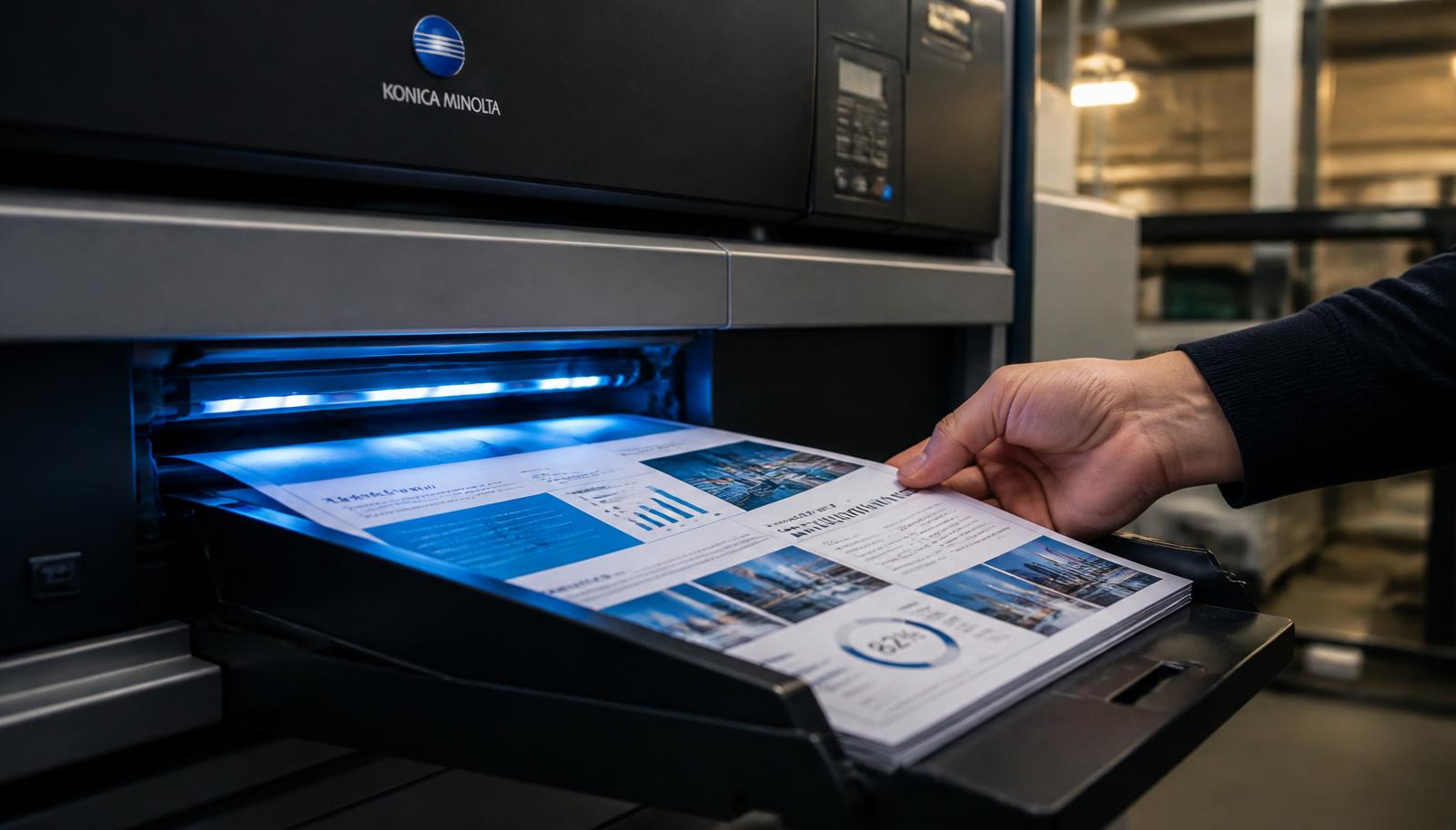
Quantity is the decision people rush, usually in one of two directions. Either they print the minimum and then reorder three times at a higher unit cost, or they print an optimistic run and store most of it for years.
The right number comes from a short, honest set of questions about distribution, shelf life and cash.
Work through them before you commit.
Why Unit Cost Falls With Quantity
Every job carries fixed effort: checking the file, setting up the run, quality checking the output. Spread across one copy that effort is expensive per copy; spread across two hundred it becomes negligible. Materials, by contrast, scale with quantity.
This is why the price curve flattens as the run grows. The first jump, from one copy to a dozen, produces a large per copy improvement. From two hundred to three hundred, the per copy improvement is small — and it is exactly there that people over order.
The Questions That Set The Number
How many copies do you have a confirmed use for right now? Not hoped for, confirmed: examiners, group members, a batch roster, a confirmed event attendance, a stocked shop order.
How long does the content stay valid? A syllabus based note set may be obsolete after one revision. A novel is valid for years. Where do the unsold or unused copies live, and who pays for that space? And what does a reprint actually cost, in both money and time, if you run short?
Obsolescence Is The Real Risk
Anything containing a date, a price list, a syllabus, a version number, a phone number or a regulation has a short shelf life. Printing five hundred copies of a document that changes next quarter converts a saving into waste.
For this class of material, print short and reprint often. Digital printing exists precisely for this pattern: no plate setup, so a reprint is straightforward and you always distribute the current version.
Sensible Buffers
For a fixed audience — a class, a panel, a group submission — order the exact number plus a small buffer of one or two for damage and last minute additions. Panels are often larger than announced.
For events and distribution, a buffer of ten to fifteen percent is normal. For a first book, print modestly, sell into your actual channel, then reprint with any corrections you discover. Almost every experienced author wishes their first run had been smaller and their second edition earlier.
Ask For Tiered Quotes
Rather than guessing where the curve flattens, ask for prices at several quantities at once — for example fifty, one hundred, two hundred and five hundred. The numbers make the decision for you and take thirty seconds to request.
You will usually see one point where the per copy price drops noticeably and then improves only marginally. That point is normally the sensible maximum unless you have confirmed demand well beyond it. Call 7289879398 with your page count, size and finishing to get the tiers.
How To Place A Printing Order With Us
The same six steps apply to every document covered in this guide.
1. Upload Document
Open the upload printout page and tap the upload area. Your device file picker opens and you can select a PDF, DOC, DOCX, JPG, JPEG or PNG file up to 150 MB. The file name, type and size are shown back to you, and you can change or remove the file before continuing.
2. Select Printing Options
Choose black & white, colour or mixed mode, and single side or double side. Mention paper weight or A3 pages here if your document needs them.
3. Enter Total Pages
Read the page count from your PDF reader rather than estimating it, and give an exact page range if only part of the document should be printed.
4. Enter Number Of Copies
There is no minimum. One copy is a valid order, and so is a run of several thousand. Copy count is what decides whether digital or offset production is cheaper for you.
5. See Estimated Price
The order summary combines pages, sides, colour mode and copies into a live estimate so you can compare options before committing to anything.
6. Submit / Request Order
Submit the request and an Order ID appears on screen. We then confirm the final amount and any delivery charge with you on 7289879398 before printing begins.
Binding, Collection And Delivery Options
Loose sheets suit drafts and anything destined for a ring file. Spiral and wiro binding lie completely flat, which is why they are the default for notes, lab records, manuals and working documents. Soft cover perfect binding gives a squared, printable spine and is the usual choice for project reports, proposals and paperbacks. Hardbinding, with foil spine text where required, is used for theses, archival record copies and premium editions. Card covers from 250 to 300 GSM, with matt or gloss lamination, can be added to any bound document and cost very little across a small number of copies.
Finished work can be collected free of charge from our counter at T-552 Baljeet Nagar, Patel Nagar, New Delhi, Delhi 110008. That is the fastest and cheapest option if you are in Patel Nagar, Baljeet Nagar, Shadipur, Karol Bagh, Rajinder Nagar, Ranjit Nagar, Kirti Nagar, Naraina or anywhere in Central or West Delhi, and it removes courier transit from your timeline entirely — which matters when a submission or a meeting is fixed. Everywhere else in India we dispatch by tracked courier. The delivery charge depends on parcel weight and your destination pin code, is paid by the customer, and is quoted before dispatch rather than added afterwards. Delhi NCR addresses in Gurugram, Noida, Ghaziabad and Faridabad are usually quickest; remote pin codes take longest. We give you dispatch confirmation and tracking instead of promising a delivery date on a courier’s behalf.
What Drives The Price
Four inputs account for almost every printing quote: total pages, number of sides, colour mode and number of copies. Pages set the volume of the job. Sides decide how many physical sheets that volume becomes, so double side printing halves paper use, document thickness and courier weight in one decision. Colour mode sets the per side rate, with black and white lowest, full colour highest, and mixed mode applying colour rates only to the pages that genuinely contain colour. Copies multiply the run, but not linearly, because file checking and setup happen once regardless of quantity and the per copy cost therefore falls as the run grows. Binding, paper upgrades, card covers, lamination and A3 pages are quoted on top, and delivery is always separate. If your job is unusual in any way, a two minute call to 7289879398 produces a firmer number than any calculator.
Ready To Print?
Upload your document, choose black & white or colour, single or double side, enter pages and copies, and see an instant estimate before you submit.