
Black & White vs Colour Printing
A decision that changes both the cost and the readability of your document. Here is how to make it deliberately.
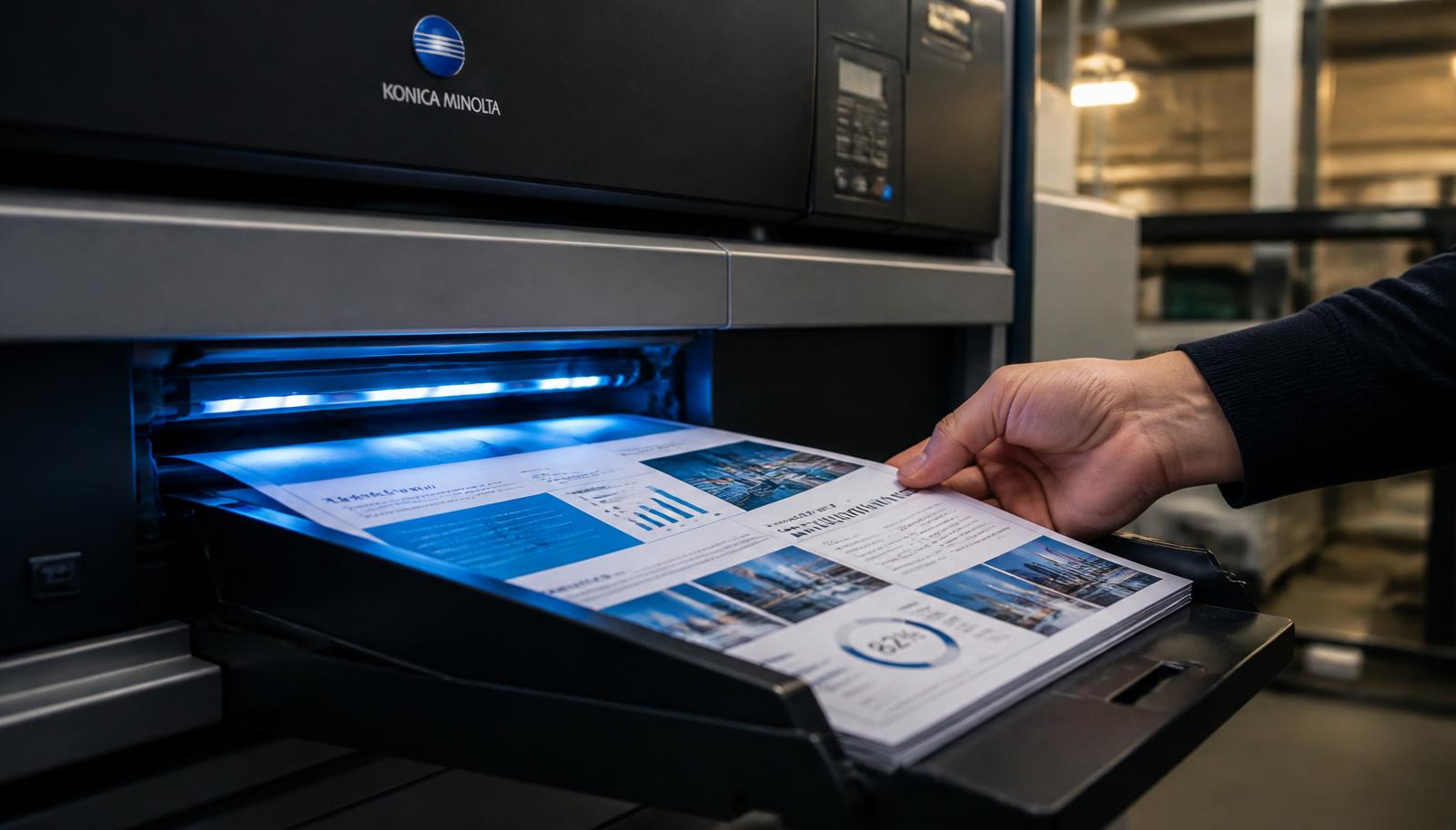
Colour mode is usually the first option on any print order form and the one people choose fastest, often without thinking. It is also one of the two decisions with the largest effect on your final bill, alongside single versus double side.
The useful question is not 'do I like colour', it is 'does colour carry information here'. If removing the colour would make the document harder to understand, pay for it. If it would only make the document slightly less pretty, do not.
Below is how that plays out across the document types we print most often.
When Black And White Is The Right Choice
Text documents are the obvious case. Assignments, essays, contracts, manuscripts, meeting papers, question banks and handwritten notes contain no information in colour, and black text on white paper is the most legible combination there is. Printing them in colour costs more and reads no better.
Black and white is also better for many scanned documents. A scan often carries a faint grey or yellow cast from the original paper; reproduced in colour that cast is faithfully printed, while black and white printing renders the same page as clean text on white. Draft copies of anything, including colour documents, are best proofed in black and white because you are checking layout, not appearance.
When Colour Earns Its Cost
Colour is worth paying for whenever meaning is encoded in it. A chart with four data series distinguished only by line colour becomes unreadable in greyscale, because three of the four lines converge into similar grey tones. The same is true of maps, circuit diagrams, heat maps, and any figure with a colour key.
The second category is documents where appearance is the product: design portfolios, architectural sheets, product catalogues, marketing material, photo books, brochures and covers. Here the printed object represents you or your organisation, and a greyscale version misrepresents the work.
Mixed Mode: The Option Most People Miss
Real documents are rarely all one or the other. A 140 page project report typically has ten pages carrying colour figures and 130 pages of plain text. Ordering the whole thing in colour means paying the colour rate 130 times for nothing.
Mixed mode charges the colour rate only on pages that actually contain colour. On a typical student project this is often the difference between an uncomfortable bill and a routine one. Tell us the colour page numbers, or ask us to follow the file, and the rest is billed as black and white.
A Practical Test Before You Order
Open your document and switch your PDF reader or your own printer preview to greyscale. Scroll through every page. Anywhere you cannot immediately tell two things apart, colour is doing real work and should be paid for. Anywhere the page reads perfectly, it should not.
If a chart fails that test but you would rather not pay for colour, there is a free fix: edit the chart to distinguish series by line style, marker shape or direct labels instead of hue. This also makes the document accessible to colour blind readers, which is a genuine improvement, not just a saving.
Cost, Paper And Durability
Colour pages cost more per page than black and white pages at every print volume, and the gap widens as the run grows. On a single copy the difference is small; on 500 copies of a 24 page booklet it is substantial and worth a conversation before production.
Paper choice interacts with colour. Colour images look flat on thin, absorbent paper and considerably better on a heavier or coated stock, because less ink spreads into the fibres. If you are paying for colour on a document that matters, ask about heavier paper for those pages rather than accepting the standard 70 GSM used for text.
How To Place A Printing Order With Us
The same six steps apply to every document covered in this guide.
1. Upload Document
Open the upload printout page and tap the upload area. Your device file picker opens and you can select a PDF, DOC, DOCX, JPG, JPEG or PNG file up to 150 MB. The file name, type and size are shown back to you, and you can change or remove the file before continuing.
2. Select Printing Options
Choose black & white, colour or mixed mode, and single side or double side. Mention paper weight or A3 pages here if your document needs them.
3. Enter Total Pages
Read the page count from your PDF reader rather than estimating it, and give an exact page range if only part of the document should be printed.
4. Enter Number Of Copies
There is no minimum. One copy is a valid order, and so is a run of several thousand. Copy count is what decides whether digital or offset production is cheaper for you.
5. See Estimated Price
The order summary combines pages, sides, colour mode and copies into a live estimate so you can compare options before committing to anything.
6. Submit / Request Order
Submit the request and an Order ID appears on screen. We then confirm the final amount and any delivery charge with you on 7289879398 before printing begins.
Binding, Collection And Delivery Options
Loose sheets suit drafts and anything destined for a ring file. Spiral and wiro binding lie completely flat, which is why they are the default for notes, lab records, manuals and working documents. Soft cover perfect binding gives a squared, printable spine and is the usual choice for project reports, proposals and paperbacks. Hardbinding, with foil spine text where required, is used for theses, archival record copies and premium editions. Card covers from 250 to 300 GSM, with matt or gloss lamination, can be added to any bound document and cost very little across a small number of copies.
Finished work can be collected free of charge from our counter at T-552 Baljeet Nagar, Patel Nagar, New Delhi, Delhi 110008. That is the fastest and cheapest option if you are in Patel Nagar, Baljeet Nagar, Shadipur, Karol Bagh, Rajinder Nagar, Ranjit Nagar, Kirti Nagar, Naraina or anywhere in Central or West Delhi, and it removes courier transit from your timeline entirely — which matters when a submission or a meeting is fixed. Everywhere else in India we dispatch by tracked courier. The delivery charge depends on parcel weight and your destination pin code, is paid by the customer, and is quoted before dispatch rather than added afterwards. Delhi NCR addresses in Gurugram, Noida, Ghaziabad and Faridabad are usually quickest; remote pin codes take longest. We give you dispatch confirmation and tracking instead of promising a delivery date on a courier’s behalf.
What Drives The Price
Four inputs account for almost every printing quote: total pages, number of sides, colour mode and number of copies. Pages set the volume of the job. Sides decide how many physical sheets that volume becomes, so double side printing halves paper use, document thickness and courier weight in one decision. Colour mode sets the per side rate, with black and white lowest, full colour highest, and mixed mode applying colour rates only to the pages that genuinely contain colour. Copies multiply the run, but not linearly, because file checking and setup happen once regardless of quantity and the per copy cost therefore falls as the run grows. Binding, paper upgrades, card covers, lamination and A3 pages are quoted on top, and delivery is always separate. If your job is unusual in any way, a two minute call to 7289879398 produces a firmer number than any calculator.
Ready To Print?
Upload your document, choose black & white or colour, single or double side, enter pages and copies, and see an instant estimate before you submit.